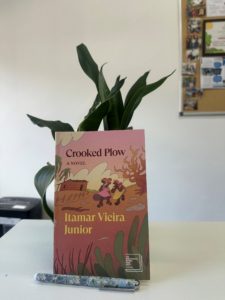
It all started with a mysterious Waterstones delivery. A couple of days after my birthday, a package arrived without any details about who sent it. Inside was a book by Itamar Vieira Junior called Crooked Plough. Knowing that I hadn’t ordered anything, I thought about who would have been kind enough to send me a book set in Bahia, Brazil, about two sisters living on a plantation whose lives are forever changed by a sharp knife. Of course, it was a friend from my undergraduate Modern Languages and Politics course who is always ready to share Spanish, Portuguese, English or French poetry with me, in its various forms.
Content in the knowledge that I didn’t have a secret admirer, I began with reading the first 10 pages. Reading for pleasure is something I always encourage language learners to do, particularly those who wish to improve their writing and comprehension skills. I find that aiming for 10 pages per day makes reading an easy habit, rather than a sporadic chore.
What can we assume the reader knows?
By page 30, I began to notice that while Crooked Plough has been translated into English by Johnny Lorenz, many words remain in Portuguese. Translation choices such as these can be made to retain the authenticity of the novel and immerse the reader in the source culture (foreignization). They can also be necessary when something doesn’t exist in the target culture, like a type of spiritual practice or a native animal. The translator will usually add an explanation, if needed, without patronising the reader. For example, on page 33, ‘comadre’ and ‘compadre’ are explained as words for godmother and godfather, as well as mother of your godchild and father of your godchild, respectively. The text continues, ‘But people referred to Zeca Chápeu Grande as compadre for a different reason: he was the spiritual father of the entire community at Água Negra.’ There is no further explanation for various reasons: firstly, the reader understands what a godparent’s job is – to spiritually guide a child as a kind of ‘co-parent’. Secondly, it can be assumed that many people would understand the words ‘madre’ and ‘padre’ and may recognise the prefix ‘co-’ as in ‘together, jointly or with’. Therefore, not only do we understand Zeca as a godfather for his community, but also as a spiritual co-parent, having a deep and meaningful relationship with all of his ‘children’ and a significant level of trust with their parents.
What can we do to keep the reader immersed?
In a similar vein, page 37 is a lesson in Brazilian flora and fauna. Whilst there are English names for these birds, the author and translator have kept these in Portuguese to further entrench the foreignization apparent in the novel. Cabeca-de-velho and sabiá-bosteira could have been translated as diademed tanager and rufous-bellied thrush, however, that immediately breaks the immersion of the Bahia campo (countryside) and could easily disrupt the pace of the book by encouraging the reader had to look up the names of birds that they’re likely unfamiliar with, given the geography of the source language culture versus the location of the reader. By keeping the names in Portuguese, the author and translator maintain the world that they have created and allow the English reader to somewhat brush past the names whilst still understanding that there are a great many beautiful, vulnerable birds sharing a habitat with the ‘crafty’ cowbirds.
When can we be creative in translation?
The creativity and room for choice in translation is somewhat unique to literary, tourism and marketing. Much public sector translation needs to be accurate to the source text whilst ensuring that there is as little room for interpretation as possible. Nuances that are apparent in the source text must be translated into the target. In a similar vein, ambiguities in the source text also need to be translated into the target unless further explanation can be provided by the writer. Not all texts are perfectly written before they are translated and synonyms exist in all languages but do not always match up to another language’s synonym. An example of this is having the same word for ‘hour’ and ‘session’ in Slovak. The following creates some confusion when session and class is used interchangeably, then, ‘You can have 14 sessions of each class. Each class is one hour long.’ With session meaning, ‘a period of time or a meeting when a particular activity takes place,’ it’s actually each session that is one hour long with classes being made up of 14 sessions. This is not a distinction that needs to be made in English, but if you replace the word session with hour, you can see how it causes confusion in Slovak. Words are not left in the source language unless needed, like addresses and names of specific processes. However, these are always explained so that texts are accessible to a reader with little to no comprehension of the source language.
Conclusions
The beauty of receiving this surprise book is that it made me think both about my translation studies and current work in the translation industry. Working with public sector translations means dealing with factual texts that are usually focused on the cultural context of this country as texts are often translated to help people to live and work here in Scotland. However, foreign literature offers opportunities to explore the cultural contexts of other countries and analyse how these are communicated in contrast to the documents that make up the usual scope of projects. Overall then it’s easy to see how a degree in translation can help you to both understand your own cultural context and also how, why and when that cultural context is communicated to people who don’t speak the language.
If you want to understand more about Bahia, Brazilian spiritual practices and the abolition of slavery in Brazil, I highly recommend Vieira Junior’s 2024 booker prize winning novel, with Lorenz’ translation into English.
If you need translation of a court document, certificate or similar, please do contact the team at hello@globalconnects.com and we’ll see how we can help.
Book credits: Crooked Plough by Itamar Vieira Junior, translated by Johnny Lorenz, published by Verso books in 2023 with cover art from Paula Saliby and Andy Pressman. ISBN: 9781839766404.