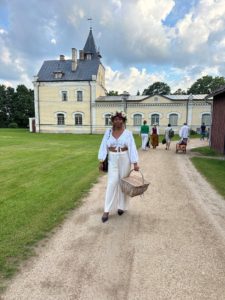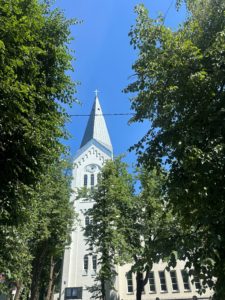
Linguists understand better than anyone how learning one language opens the door to many others. One of the oldest Indo-European languages and an official language of the European Union, Latvian is spoken by around 1.6 million people worldwide. It has influences from German, Swedish, Polish, and Russian languages, and is closely related to Lithuanian. In Latvia, all names in official documents have to conform to the phonetic and grammatical rules of the Latvian language. The Latvianisation of names can be tricky in a global context due to phonetic spellings which create differences between ID documents. Doing so, however, is one of the examples of the strength of the Latvian language, which I was able to appreciate in various ways when visiting for this year’s Midsummer (Ligo and Jāņi) celebrations.
1. Accents aren’t scary!
Even as a linguist, sometimes you land in a country, see the signage at the airport and feel really privileged to have the English translation readily available underneath. In particular, languages using different alphabets can be daunting, but Latvian is actually relatively easy to pronounce once you know the rules. With the Latvian alphabet being made up of 33 letters, 22 of those being unmodified Latin letters and 11 being modified with diacritics (written accents), Latvian words are written phonetically. Written accents (ā č ē ģ ī ķ ļ ņ š ū ž) include macrons to show length (–), carons (ˇ) and cedillas (,) which change the way a letter is pronounced or where the stress would be on a word. My favourite example of this was the caron in čau pronounced the same as ciao (Italian) or chao (Spanish, Portuguese), because it helped me to remember what the caron did without having to think too hard. It also felt very “European summer” using čau though I did use sveiki (hi) and labdien (good day) too.
Given that I sat in hours of Spanish linguistics lessons at the Universidade de Santiago de Compostela, and took GCSE German, Latvian words like zobārstniecība (place of the tooth doctor i.e. dentist) weren’t too surprising or intimidating overall.
2. Too Bri’ish?
That said, my pronunciation wasn’t perfect and I had to be brave about trying things out. You know how it goes when you’re learning a new language, avó and avô (Portuguese for grandma and granddad) sound the same and you have to guess from the context. There’s a subtle difference that you can’t quite hear or imitate. Not only that, but being multilingual, you get an extra layer of language to confuse native speakers about where your mispronunciation comes from. In my case, it was quite the compliment to hear, “You sound so Spanish!” instead of, “Typical Brit!” when putting an emphasis on the wrong part of a word. By the end of the 10 days, I was getting compliments on my pronunciation of some words – progress!
3. The countryside up close
At 21, equipped with two years of formal Spanish study and a dream, I went off to the Catalan countryside to live with a family I’d never met and share the best of British culture with them. Having grown up in east London, it was a bit of a culture shock just going from my leafy suburb to actual Essex (the part where your Oyster card doesn’t work) for university. Being an au pair was a step up again – miles of fields, mountains and lakes, not skyscraper to be seen. It was exciting, but at times I did feel a bit out of place in such rural environments with only a basic understanding of the Catalan language. That said, I developed such an appreciation for outdoor spaces, long nights by the fire and hearing songs in a language I can only partly understand that Midsummer felt familiar. It’s part of what drew me to living in Scotland too, with lochs, munros and endless fields only a 45-minute train ride away from any city.
4. These are not my own traditions (and that’s okay)
As you can imagine, having spent time in the Catalan countryside experiencing calçotadas, annual village fetes and everyday life, I’m no stranger to celebrating traditions in cultures that are not my own. Even carnival is celebrated very differently to the Caribbean carnivals that I’m used to. Had I not been learning Spanish, and open to learning Catalan, I would never have experienced all that was on offer there. That meant that celebrating Midsummer in Latvia, whilst being a brand new experience, also felt familiar. I didn’t mind not being able to sing the beautiful folk songs that everyone knew the words to around me. Instead, I let the crackling flames of the fire and the soothing choral tones hypnotise me as I tried to stay up until sunrise. I couldn’t always feel fully included, but I next felt excluded either. Trying to pronounce the names of typical dishes and traditional clothing was tough, but it was fun to give it a go and learn more about Lielvārdes jostas (weaved belts), ziedu vainagi (flower crowns) and ozollapu vainagi (oak leaf crowns).
5. Creating moments of connection
Learning languages creates connection in small moments and big ones. Even stepping out of a taxi becomes different. What would you usually say? “Thanks, goodnight,” or some variation of that, right? I tried to mimic what people would say which resulted in wishing people, “ar visu labu” (all the best with you) which wasn’t quite right. In fact, it was a mixture of visu labu (all the best) and ar labunakti (goodnight), but no one made me feel bad about it and I got a few laughs while trying to figure it out too.
Finally, speaking another language means you can bond with other people in your language community anywhere in the world. For me, “¿Hablas español?” has always opened doors to many a conversation reminiscing about years abroad full of tapas and siestas. It was exciting being able to use Spanish around new people and feel a little more understood by doing so while we lamented not speaking Latvian.
Conclusion
Overall, learning Spanish helped me to navigate Latvia by giving me a linguistic foundation that made accents less daunting, turned attention away from my British accent, immersed me in the countryside and other people’s traditions, and made me brave enough to try. To top this all off, I am able to connect with other hispanohablantes wherever I go. Most young Latvians speak English fluently, and many Latvians have some understanding of it. That said, I always find that speaking just a small part of the language of the country you’ve visiting makes your experience so much more enjoyable, authentic and connected. So, where will languages take you?
Sources:
LSM https://eng.lsm.lv/article/society/latvians-abroad/14.07.2026-latvias-way-with-surnames-can-cause-problems-in-other-countries.a654964/
Wikipedia https://en.wikipedia.org/wiki/Latvian_orthography